


Table of Contents
Coordinating PR and legal during a crisis means aligning communication speed with legal compliance. This is done through shared protocols, joint decisions, and pre-approved messaging frameworks. This approach lets an organization respond clearly under pressure, protecting stakeholder trust and its legal position at the same time.
When these teams are misaligned, it can quickly increase liability and damage public credibility. The goal is a single, unified voice that meets both regulatory obligations and public expectations. To understand how this coordination functions in real scenarios, keep reading for the practical methods we use at BrandJet.
Key Takeaway
- Clear role definitions prevent conflicting advice and reduce response delays during high pressure crisis situations.
- Pre approved messaging enables faster communication without exposing the organization to unnecessary legal or regulatory risk.
- Joint governance structures help leadership make balanced disclosure decisions that align with stakeholder expectations and compliance duties.
How can PR and legal teams align goals before a crisis hits?
PR and legal teams can align their goals before a crisis by agreeing on shared protocols that balance public disclosure with legal liability. This upfront work drastically reduces friction when you need to act fast.
Alignment starts by acknowledging their different priorities: PR cares about trust and clarity, while legal focuses on exposure and compliance, a dynamic reinforced in legal PR coordination examples from real-world crisis scenarios.
Effective alignment depends on documented agreements. It also requires both teams to use the same risk assessment language to make quicker decisions.
Key actions for pre-crisis alignment:
- Define thresholds in writing: Agree on what constitutes reputational harm versus legal exposure, and review these annually.
- Agree on transparency scenarios: Decide in advance when transparency is legally required or outweighs caution, like during a data breach.
- Establish disclosure protocols: Set clear standards for what to tell different stakeholders, employees, investors, regulators, and media.
- Clarify roles and rights: Map out decision rights for PR, legal, and executives. Assign a crisis liaison and document any veto powers to avoid disputes.
This preparation builds muscle memory. When a crisis hits, teams can act immediately instead of wasting time negotiating.
What joint crisis governance model works best in practice?

The most effective joint crisis governance model in practice is a standing committee with PR, legal, and executive members.
This collaboration is vital because, as noted by industry experts :
“Amid a crisis, co-ordination between lawyers and public relations is not a matter of choice, but a matter of survival… working with PR teams, they [lawyers] form twin lines of defence, safeguarding companies against reputational and legal risk.” – Law.asia [1]
At BrandJet, we recommend a cross-functional team that meets quarterly and activates immediately during an incident. This committee usually includes communications and legal leadership, operations, HR, and an executive sponsor.
Key roles in a standing committee:
- PR Lead: Manages the unified public narrative and media relations.
- Legal Lead: Oversees regulatory compliance in messaging and liability mitigation.
- Executive Sponsor: Makes the final call when difficult trade-offs arise.
Different governance models suit different risk levels. Comparing them helps teams choose intentionally rather than reactively.
| Model | Speed | Risk Control | Use Case |
| Ad hoc group | High | Low | Minor incidents |
| Standing committee | Medium High | High | Major crises |
In short, this formal governance isn’t bureaucracy, it’s an essential tool for efficient action when uncertainty is high.
How should approval workflows be structured without slowing response time?
Tiered approval workflows are the best way to keep responses fast without ignoring legal risk, an approach emphasized in preventing legal backlash during crisis frameworks for modern corporate teams. This structure lets low-risk factual updates move quickly while reserving full legal review for statements tied to litigation or major liability.
Speed is critical, silence fuels speculation, but unchecked speed can create compliance or defamation problems.
A tiered system works by matching the intensity of the review to the level of risk, instead of sending every message through the same slow process.
A basic three-tier structure:
- Tier One: Factual updates using pre-approved language from a crisis library.
- Tier Two: Statements with reputational risk that need a rapid legal check.
- Tier Three: High-stakes communications, like litigation-related announcements, requiring full counsel review.
The foundation is a library of pre-vetted messages. This includes holding statements, social media replies to rumors, and internal FAQs for employees. Having this approved language ready drastically cuts drafting time and uncertainty.
Clear workflow rules prevent bottlenecks. When everyone knows what can be sent and when, you maintain both speed and control.
How do PR and legal decide what to disclose during high risk moments?

Deciding what to disclose in a high-risk moment requires a joint assessment by PR and legal, weighing reputational damage against legal risks like losing privilege or breaking regulatory rules.
This is the toughest part of coordination. Legal fears creating evidence or admissions, while PR fears that silence will be filled with damaging speculation, a challenge explored in crisis management studies and best practices.
The assessment starts with legal obligations, like data breach notification laws or SEC disclosure rules, which often dictate the timing. From there, teams evaluate other key factors.
The core criteria for disclosure decisions:
- Legal deadlines: What are the mandatory reporting requirements and statutory deadlines?
- Stakeholder impact: How severe is the actual or potential harm to customers, employees, or partners?
- Escalation risk: What is the likelihood the situation will trigger litigation or a formal investigation?
Teams must separate verified facts from speculation. It’s possible to show empathy and concern, phrases that are legally vetted, without making an admission of fault. You can state that an investigation is ongoing and commit to providing updates on a set schedule.
This balanced approach aims to protect public trust and the organization’s legal position at the same time.
What training and simulations improve PR legal coordination?
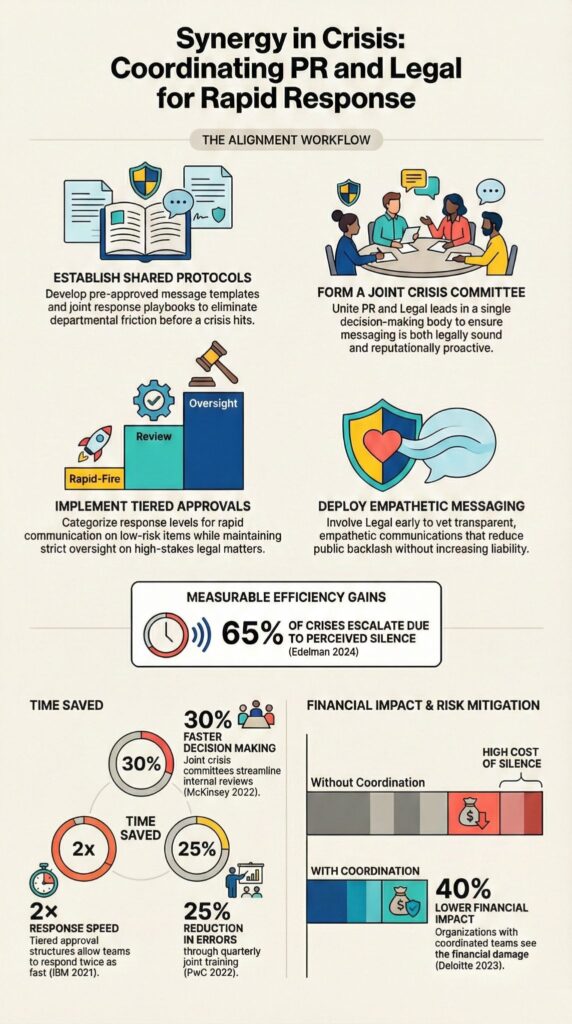
Quarterly tabletop exercises and cross-training are the most effective ways to improve PR-legal coordination. Training builds essential trust during calm periods, so teams understand each other’s constraints before a high-pressure crisis hits. This familiarity prevents burnout and costly misalignment when it matters most.
Academic research highlights that this shift in mindset is a growing industry standard. According to a study published :
“PR consultants report that legal professionals have begun to realize the significance of winning in the court of public opinion… [they] develop co-narratives for optimal crisis management, and understand how their different professional [perspectives] serve as viable strategies.” – Public Relations Review [2]
Key elements of effective training:
- Realistic tabletop exercises: Use timed, realistic scenarios that include executives.
- Thorough debriefs: Hold after-action reviews to analyze outcomes and improve processes.
- Cross-functional learning: Have PR learn legal basics like privilege protection, and have legal practice spokesperson training.
This cross-training reduces friction. PR learns why legal pushes for caution, and legal understands the urgency of media cycles. Teams that train together with unified crisis examples simply perform better under real pressure.
What lessons do real world crises reveal about PR legal collaboration?
Credits : Alex MacGregor
Real-world crises consistently show that involving legal advisors early, while still delivering empathetic public messages, is what limits backlash and shortens reputational damage. When legal and PR timelines are coordinated from the start, aligning regulatory notices with customer updates, it reduces public confusion and market volatility.
The same pattern holds in corporate scandals. Outcomes improve when a CEO acts as a unified spokesperson following a joint crisis plan.
Key lessons from past crises:
- Acknowledge immediately without speculating on causes.
- Coordinate all timelines for regulators, media, and customers.
- Centralize authority in a single, prepared spokesperson.
A major lesson is that silence rarely protects a reputation. Excessive legal caution often creates an information vacuum that rumors quickly fill. Learning from these failures helps teams build better playbooks.
Practical takeaways for playbooks:
- Avoid prolonged silence, even during an internal investigation.
- Maintain a consistent, approved flow for all talking points.
- Always schedule a post-crisis debrief with both legal and PR to review what happened.
In the end, experience proves that this preparation is what works under pressure.
FAQ
How should our crisis communication strategy balance transparency with legal hold during a fast-moving emergency?
Start with a crisis communication strategy anchored in a joint crisis response plan led by a cross-functional crisis team of PR and legal.
Define a stakeholder disclosure protocol in advance. Use rapid response messaging based on verified facts and real-time legal advice PR. Operate with a decision matrix crisis and escalation protocols crisis so approvals, timing, and accountability are documented.
How can legal PR coordination protect privilege while enabling timely media relations legal review?
Structure legal PR coordination around pre-approved statements crisis stored in your crisis playbook development. Keep legal counsel PR collaboration continuous but separate factual investigation from message drafting to protect privilege protection PR.
Route every public document through a strict press release approval process and talking points approval flow with time-stamped records. This creates accountability and an auditable decision trail later.
What roles should the CEO, board, and spokesperson play in shaping a unified crisis narrative?
The CEO crisis communication role is to set tone, accept responsibility, and avoid speculation. Board oversight crisis response focuses on litigation risk PR, regulatory exposure, and resource allocation crisis phase.
Trained spokespeople rely on message map development and Q&A preparation legal to stay aligned. A daily war room setup PR legal uses a shared situation report template for real-time clarity.
How do we align disclosure timing strategy with data breach law and SEC or GDPR rules?
Integrate data breach notification law, SEC disclosure requirements, and GDPR compliance PR into one master calendar. Assign an interdepartmental crisis liaison to manage regulatory filing coordination and media updates.
Balance transparency vs legal hold by sequencing statements, confirming facts, and documenting verification before each public release. Board oversight crisis response reviews timing to reduce regulatory penalties and reputational harm risk.
How should we conduct post-crisis debrief legal while preventing burnout and crisis fatigue?
Schedule a structured post-crisis debrief legal with PR, operations, and external auditors. Produce a lessons learned report legal and update crisis playbook development. Run crisis simulation exercises to test fixes.
Manage burnout legal team crisis through workload rotation, clear resource allocation crisis phase, and formal remediation plan announcement. Track crisis fatigue prevention and adjust staffing across departments quarterly for resilience.
Coordinate PR and Legal During a Crisis With Confidence
Coordinating PR and legal during a crisis demands structure, practice, and shared accountability. When teams align before an incident, their response is faster, clearer, and more legally defensible. Success comes from established protocols, not improvisation.
At BrandJet, we help teams monitor early risk signals, coordinate their messaging across departments, and act with confidence when it matters most. To build this capability for your organization, learn how BrandJet supports coordinated crisis response across all channels.
References
- https://law.asia/lawyers-public-relations-collaboration-crisis-management/
- https://www.researchgate.net/publication/222939630_Public_Relations_and_the_Law_in_Crisis_Mode_Texaco’s_Initial_Reaction_to_Incriminating_Tapes

More posts

Prevent Internal Misinformation in Organizations
Prevent internal misinformation by establishing clear communication protocols, verification processes, and a culture...

Internal Crisis Communication: How Teams Stay Aligned
Internal crisis communication is the process organizations use to share clear, accurate information with employees...
Influencer Crisis Detection for Modern Brands
An influencer crisis can cost you trust and revenue. It’s about spotting the danger signs before they blow up. The...