


Table of Contents
A crisis recovery content strategy is a structured, long-term plan to rebuild trust and reshape public narrative after a crisis using owned, earned, and social content. It begins once the initial response ends and focuses on documented proof of change, not temporary damage control.
At BrandJet, we approach recovery as a measurable discipline because negative coverage remains indexed across search engines, forums, and video platforms long after headlines fade.
Most consumers read online reviews before buying in 2023, showing how lasting digital records shape perception. If recovery content does not rank, it is overlooked. Keep reading to see our roadmap.
Key Takeaways
- A crisis recovery content strategy replaces negative narrative with documented proof, not defensive statements.
- Recovery content must answer stakeholder questions about accountability, safety, and future stability.
- Measurable sentiment tracking and SEO architecture determine long term online reputation recovery.
What Is a Crisis Recovery Content Strategy?
A crisis recovery content strategy is our structured, phased approach to rebuilding brand trust after a public issue. We focus on replacing the narrative with documented proof and measurable reputation repair.
As highlighted by FEMA
“…effective communications require understanding your audience, conducting pre‑incident preparedness campaigns… communicate clearly to support response and recovery operations.” – FEMA
Recovery starts after our urgent response ends. In the first days, we address immediate facts. After that, we shape the longer story. This distinction matters because indexed content remains searchable for years across search engines, forums, and video platforms. Digital memory does not fade on its own.
We do not rely on deletion. Attempts to remove content often draw more attention. Instead, we publish stronger, transparent material that earns visibility and gradually shifts search results and stakeholder perception.
Our core principles include:
- We replace narratives rather than trying to erase them.
- We align content with stakeholder intent and search behavior.
- We publish transparent updates that show policy, process, and measurable change.
- We prioritize clarity over defensive language.
When we commit to visibility and accountability, recovery becomes structured progress instead of reactive silence.
Why Does Narrative Replacement Matter More Than Damage Control?

Narrative replacement matters to us because crisis content is already indexed and visible. Our recovery depends on publishing stronger, proof-driven content that outranks and outperforms negative coverage. Deleting content rarely removes traces from search engines, social platforms, or video sites like YouTube, and attempting removal can draw even more attention.
Insights from West Virginia University indicate
“Sustaining effective communications with various constituencies… is crucial in recovery and restoration stages days and weeks after the actual event.” – West Virginia University
We focus on sustained publication instead of reactive removal. Key steps we follow include:
- Publishing proof-based blog posts and landing pages
- Creating FAQs that answer stakeholder questions
- Updating content consistently to maintain search visibility
- Amplifying updates through social and earned media channels
The difference becomes clear when we compare approaches:
| Approach | Goal | Risk | Long-Term Impact |
| Removal | Delete negative content | Draws more attention | Short-lived |
| Replacement | Publish proof-based content | Requires sustained effort | Compounding trust gains |
Because indexed crisis memory persists, we ensure our content aligns with stakeholder intent. Without consistent updates, negative posts dominate search queries.
Who Is Crisis Recovery Content Actually For?
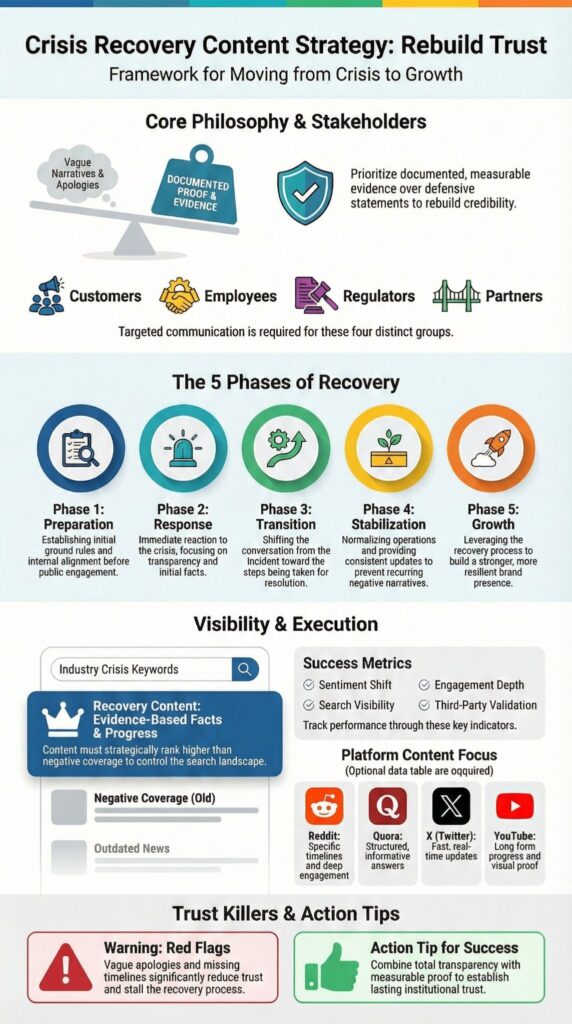
Crisis recovery content is for our customers, employees, regulators, and partners, each with specific concerns about accountability, safety, and long-term stability. It helps us communicate clearly, show measurable progress, and rebuild trust after a public issue.
We address different questions for each group:
- Customers: We reassure them with content explaining how products, services, and data are protected, and how we prevent future incidents.
- Employees: We provide internal communications outlining policy changes, training updates, and leadership actions to maintain confidence and clarity.
- Regulators: We document audits, certifications, and compliance improvements, showing proactive remediation and adherence to standards.
- Partners: We share metrics-based updates demonstrating operational stabilization, risk mitigation, and reliability improvements.
For example, a stakeholder FAQ might read: “As of March 2026, 100% of impacted systems have been independently audited, and corrective controls are active.” By providing this level of specificity, we strengthen digital reputation repair, maintain transparency, and rebuild trust across all audiences while guiding them through our post-crisis recovery process.
What Is the 5 Phase Crisis Recovery Content Framework?

Our crisis recovery framework turns corrective action into structured, visible, and measurable trust signals. We use a five-phase playbook inspired by structured communications models, ensuring each step builds on the previous while allowing overlap in execution, integrating lessons from crisis management strategies.
Preparation
- Objective: We document gaps and corrective commitments.
- Asset: Internal timeline draft and crisis recovery governance checklist.
Response
- Objective: We publish apology content and initial fixes within 24 hours when possible.
- Asset: Leadership messaging post and crisis recovery explainer page.
Transition
- Objective: We share documented progress within weeks two to four.
- Asset: Crisis recovery timeline with measurable milestones.
Stabilization
- Objective: We demonstrate sentiment shift through consistent updates.
- Asset: Case studies and results pages.
Growth
- Objective: We rebuild authority through thought leadership and values-aligned storytelling.
- Asset: Whitepapers and webinars.
For us, measurable reputation stabilization usually takes six to twelve months depending on severity. Each phase ensures we produce indexed proof, not isolated statements, so stakeholders can track recovery progress and trust rebuilding.
What Questions Must Our Content Explicitly Answer?
Our recovery content must address accountability, proof of change, personal impact, and independent validation to rebuild credibility effectively.
We know stakeholders want evidence, not general statements, and they seek clarity on how issues directly affect them and how oversight is maintained. Clear, structured answers build trust over time and connect to best practices on improve prevention workflows for risk mitigation.
We organize our content around key intent clusters:
- Accountability and Evidence
- Asset: Crisis recovery audits and certifications content
- Example headline: “What We Changed After the Incident”
- Proof element: Named executive oversight and audit reports
- Practical Impact
- Asset: Crisis recovery FAQs and customer stories
- Example headline: “How This Affects Your Account”
- Proof element: Step-by-step protection guidance
- Trust Signals
- Asset: Crisis recovery testimonials and reviews
- Example headline: “Independent Partners Confirm Compliance”
- Proof element: Third-party validation
By mapping these questions into our crisis recovery content hubs, we strengthen SEO, maintain long-term SERP visibility, and provide continuous, evidence-backed reassurance. Our approach ensures stakeholders can find clear answers, track progress, and regain confidence in our brand over time.
How Should Our Content Differ Across Reddit, Quora, X, and YouTube?
Credits : Riverside Health
We know each platform rewards different signals, so our crisis recovery messaging must adapt structure, tone, and pacing to meet audience expectations.
- Reddit: We prioritize specificity and documented timelines. Users respond to named owners and deadlines, while vague statements get skepticism quickly.
- Quora: We use structured frameworks. Numbered phases, clear roles, and crisis recovery case studies establish authority.
- X (formerly Twitter): Speed matters. We aim to acknowledge issues within 24 hours. Plain-language threads outlining facts and fixes get higher engagement.
- YouTube: We publish long-form documentary-style content that shows our journey over months rather than promising rapid fixes.
| Platform | Tone | Structure | What Wins |
| Direct and specific | Timeline with receipts | Named owners and dates | |
| Quora | Structured | Framework driven | Clear phases |
| X | Plain language | Thread updates | Fast acknowledgment |
| YouTube | Transparent | Documented log | Visible progress |
By aligning our content to each platform, we ensure our social posts and video series feel native, maintain credibility, and effectively communicate recovery progress to our audiences.
FAQ
How do I build an effective crisis recovery content strategy?
To build an effective crisis recovery content strategy, start with a structured crisis recovery framework and a clear crisis recovery roadmap.
Conduct detailed crisis recovery content audits to identify tone issues, factual gaps, and content risks. Define crisis recovery messaging, brand voice, governance rules, and an approvals process. Then develop a crisis recovery content calendar that aligns with stakeholder trust restoration goals and measurable performance metrics.
What content supports reputation restoration after a public crisis?
Reputation restoration requires structured crisis management content that explains what happened, what has changed, and how issues are being resolved.
Use transparency content and a clear apology content strategy to address responsibility directly. Strengthen online reputation recovery with crisis recovery testimonials and reviews, third-party validation, and documented process improvements. Consistent digital reputation repair efforts build credibility over time.
How should post-crisis communication rebuild brand trust?
Effective post-crisis communication must focus on empathy-driven content, leadership messaging, and verified policy changes. Explain crisis recovery process improvements, training updates, and governance adjustments in clear language.
Use crisis narrative control responsibly by presenting complete facts and measurable outcomes. Brand trust rebuilding depends on stakeholder trust restoration, values-driven storytelling, and sustained trust-based marketing that proves accountability through action.
Which formats work best for crisis recovery messaging?
The most effective crisis recovery messaging uses a structured mix of crisis recovery blogs, video series, social posts, and email campaigns.
Create a dedicated crisis recovery landing page, explainer content, and crisis recovery FAQs to guide user journeys clearly. Support this ecosystem with search-focused articles and micro-content as part of a defined crisis recovery SEO strategy to strengthen visibility and consistency.
How do I measure success in a crisis aftermath strategy?
A strong crisis aftermath strategy measures sentiment analysis, social listening insights, search performance, and engagement with crisis recovery content hubs. Track performance across crisis recovery email campaigns, testimonial content, and customer reassurance content.
A metrics-based crisis recovery playbook should connect workflow efficiency, governance compliance, and content performance data to measurable improvements in reputation, stakeholder trust, and revenue stability.
Building a Sustainable Crisis Recovery Content Strategy with BrandJet
Trust is fragile, and recovery is deliberate. Every article, FAQ, or micro-update either rebuilds credibility or lets doubt linger. We decide whether our audience remembers our resilience or the crisis itself. Recovery is earned, measured, and structured, not left to chance.
With BrandJet, we align human insight with AI perception, track KPIs in real time, and maintain governance that scales.
We monitor mentions across social and AI platforms, analyze sentiment, and measure perception shifts to guide decisions. By building a sustainable framework, we protect our brand’s reputation and turn crisis into credibility, controlling our narrative with clarity and authority.
References
- https://www.forbes.com/sites/edwardsegal/2021/05/24/the-importance-of-holding-crisis-management-debriefs/
- https://fundraiseup.com/blog/emergency-fundraising/
Related Articles

More posts

Prevent Internal Misinformation in Organizations
Prevent internal misinformation by establishing clear communication protocols, verification processes, and a culture...

Internal Crisis Communication: How Teams Stay Aligned
Internal crisis communication is the process organizations use to share clear, accurate information with employees...
Influencer Crisis Detection for Modern Brands
An influencer crisis can cost you trust and revenue. It’s about spotting the danger signs before they blow up. The...