


Table of Contents
A crisis recovery timeline is a structured plan that maps the journey from immediate stabilization to long-term rebuilding. It defines distinct phases, often spanning weeks, months, or even years, to align decisions, communication, and resources after a major disruption.
This structured approach is used by organizations enterprise risk teams worldwide. Understanding these phases transforms recovery from a vague concept into a manageable series of steps.
When you understand how recovery actually unfolds in practice, you can plan deliberate actions instead of just reacting under pressure. Continue reading to see real-world examples of these timelines and how we approach them at BrandJet.
Key Takeaways
- Crisis recovery timelines work best when phases, exit criteria, and metrics are clearly defined from the start.
- Recovery duration varies widely, but most follow predictable stages across business and personal contexts.
- Monitoring perception and communication during recovery directly affects long-term outcomes.
What Is a Crisis Recovery Timeline and How Does It Work?
A crisis recovery timeline is a phased plan that maps out the actions needed to move from immediate stabilization to long-term improvement. It aligns your people, operations, and communications over a period that can span weeks to years after a disruption.
The timeline works because it sets clear expectations. Leaders know what defines success in each phase, teams understand their priorities, and stakeholders know what kind of updates they’ll receive.
Without this structure, recovery efforts frequently stall or repeat past errors. In practice, timelines are living documents that evolve as new information comes in, especially when dealing with the nuances of reputational or psychological recovery.
How a recovery timeline functions:
- Provides structure: It breaks the overwhelming task of “recovery” into manageable, sequential phases.
- Sets expectations: It clearly defines goals and communication plans for leaders, teams, and stakeholders.
- Serves as a coordination tool: At BrandJet, we see it as a way to connect operational fixes with communication strategy and perception tracking.
It’s important to remember that timelines are frameworks, not guarantees. External factors like new regulations, shifting public sentiment, or resource constraints can shorten or lengthen any recovery period.
What Are the Standard Phases in a Crisis Recovery Timeline?

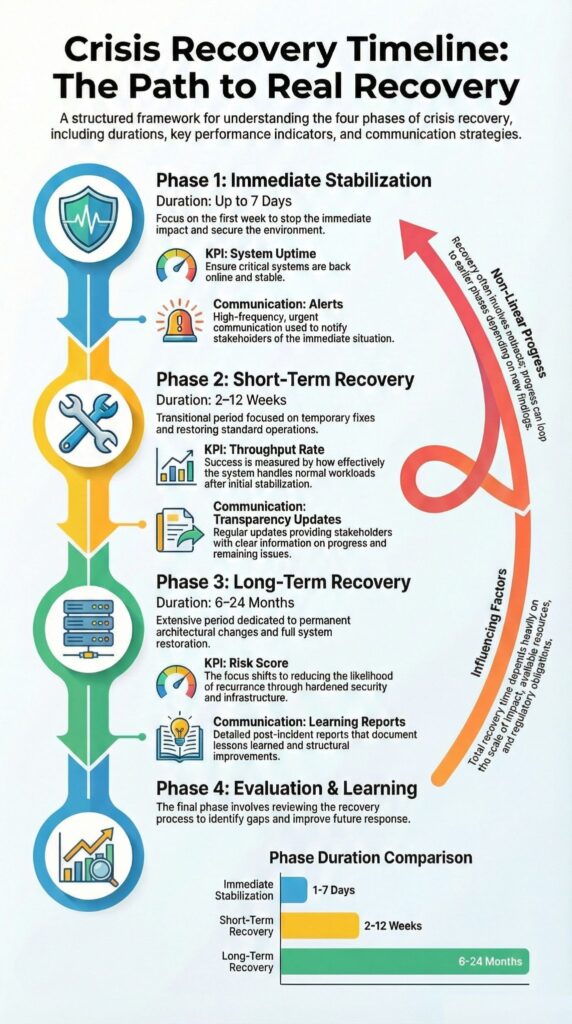
Most crisis recovery timelines move through four standard phases: stabilization, restoration, normalization, and evaluation. The logic is consistent: first, stop the damage; second, restore what’s essential; third, rebuild for resilience; and finally, learn from what happened.
As noted by industry experts, the transition from immediate chaos to a resolved state is highly variable:
“Depending on the type of crisis, this final crisis resolution stage can take days, weeks, or even months. What to do during the post-crisis stage: Recover. During this crisis phase, you may need to assess and repair damage to buildings or other assets so the business can resume normal operations.” – AlertMedia [1]
The four standard phases:
- Stabilization: Focuses on immediate safety, threat containment, and establishing a single source of truth.
- Restoration: Works to restore core functions with temporary solutions while planning for the long term.
- Normalization: Embeds permanent fixes, updates policies, and builds resilience over months or years.
- Evaluation: Reviews the entire process to capture lessons and improve future responses.
Each phase has clear goals and measurable outcomes, which supports accountability. Key actions are securing people and data, containing damage, and establishing clear command.
What Does a Business Crisis Recovery Timeline Look Like?
A business crisis recovery timeline focuses on rapid control, rebuilding operations, and reviewing governance, all tracked with clear milestones. These plans often align with standards for business continuity, with many companies targeting key recovery checkpoints within the first 90 days. It’s crucial to measure operational, financial, and reputational progress; without metrics, recovery is just a guess.
At BrandJet, we emphasize tracking perception recovery, how stakeholders and AI systems discuss your brand, alongside operational fixes to protect long-term trust.
A typical business timeline has three phases:
- Stabilization: Immediate damage control, command activation, and unified messaging.
- Rebuilding: Restoring core functions by fixing processes and systems.
- Review: Conducting audits, updating training, and improving governance.
Here’s a concrete example for a corporate operations crisis:
| Phase | Duration | Key Actions | KPI |
| Stabilize | 7 days | Activate incident command, unify all messaging. | System Uptime |
| Rebuild | 12 weeks | Implement process and system fixes. | Throughput Rate |
| Review | 12 months | Conduct audits, update training, revise policies. | Risk Score |
The first week demands leadership visibility and message consistency. The rebuild phase is measured by efficiency. The final review phase focuses on reducing your overall risk score through systemic improvements.
How Do Regulated Industries Adjust Recovery Timelines?

Recovery timelines in regulated industries like banking, healthcare, and energy are almost always longer. While these requirements slow the process, they also force a more thorough review that can reduce long-term legal and financial risk. Timelines must build in time for regulatory approvals before any fixes are considered final.
Organizations in these sectors often use dashboards to track compliance milestones right alongside their operational recovery metrics, as missing a single reporting deadline can effectively reset their progress.
Key adjustments for regulated recovery timelines:
- Additional approval stages: Building in formal review and sign-off from legal and compliance teams at multiple points.
- Extended communication: Following strict protocols for notifying regulators and other official bodies.
- Formal assessment reports: Producing detailed, auditable post-crisis reports for regulatory submission.
Because of these complexities, recovery planning in regulated sectors must integrate legal and compliance experts from the very beginning, not as an afterthought.
What Are Personal or Mental Health Recovery Timeline Examples?
Personal or mental health recovery follows a non-linear path focused on safety, processing, and reconnection over months or years. Three core stages, but unlike a business timeline, progress here is deeply personal and often includes expected setbacks, which reflect the nervous system adapting, not failure.
Recovery is measured by internal milestones like better emotional regulation, restored daily routines, or improved relationships, rather than traditional business KPIs. Understanding this helps organizations support employees with realistic expectations.
The three stages of psychological recovery:
- Safety and Stabilization: Establishing physical and emotional safety, and regaining a sense of basic control.
- Processing and Meaning-Making: Working through the trauma or crisis with therapeutic support to understand and integrate the experience.
- Reconnection and Growth: Rebuilding a sense of identity, re-engaging with relationships, and finding new purpose.
Stages commonly unfold over 12 to 36 months. Movement isn’t a straight line; individuals often cycle back to earlier phases. The duration is strongly influenced by the quality of support systems, access to care, and flexibility in environments like the workplace.
How Long Does Crisis Recovery Usually Take?
Credits : Ricardo Vargas
The duration of crisis recovery depends entirely on the impact, available resources, and any regulatory hurdles. It can range from a few weeks for a minor, contained event to multiple years for a deep, systemic crisis.
Official research emphasizes that true recovery, where new consumer behaviors actually stabilize, often operates on a multi-year horizon rather than a quarterly one:
“6 months into the crisis: prioritising value for money… 5 years on: New consumer habits start to stick. After the last recession, new shopping behaviours became the norm as consumers saw the benefits of comparing prices, waiting for discounts, and starting their shopping early to snag better deals.” – Think with Google [2]
Key factors influencing recovery time:
- Impact severity: A localized IT outage versus a company-wide data breach.
- Regulatory environment: Highly regulated sectors face longer timelines due to mandatory audits and reporting.
- Resource availability: Access to financial reserves, skilled personnel, and leadership bandwidth.
- Pre-existing readiness: Whether robust crisis plans and trained teams were in place beforehand.
It improves team morale and leads to better decision-making throughout the long recovery process, preventing the frustration of constantly missed deadlines.
FAQ
How long does a typical crisis recovery timeline usually take?
A crisis recovery timeline varies based on crisis type, severity, and preparedness. Short-term crisis response may last days or weeks, while long-term crisis recovery can take months or years.
The crisis stabilization phase, available resources, and recovery milestones post-crisis strongly influence timing. There is no single typical crisis recovery time, so realistic planning and phased crisis recovery are required.
What are the main recovery phases after a crisis?
Recovery phases after crisis typically include the crisis stabilization phase, rebuilding after crisis, and long-term crisis recovery. These phases align with common crisis management stages and crisis repair stages.
Organizations and individuals also conduct post-crisis stabilization and post-crisis evaluation. Defining these crisis restoration phases creates a clear crisis recovery roadmap and improves recovery benchmarking.
How can I create a practical post-crisis recovery plan?
A practical post-crisis recovery plan should define short-term crisis response actions and long-term rebuilding goals. The plan should include clear crisis recovery steps, crisis recovery strategies, and recovery milestones post-crisis.
It should also include recovery progress tracking and crisis recovery metrics. A documented organizational recovery plan or personal plan improves accountability and execution.
How do psychological and business recovery timelines differ?
A psychological recovery timeline or trauma recovery timeline is often longer and less predictable than business crisis recovery. Mental health crisis recovery depends on emotional support, stress exposure, and coping capacity.
Business crisis recovery focuses on financial crisis recovery, operational crisis recovery, and reputational damage recovery. Each requires a different crisis recovery framework and timeline management approach.
How can I measure whether crisis recovery is on track?
Crisis recovery can be measured using crisis recovery KPIs, recovery progress tracking, and crisis recovery metrics. Recovery benchmarking and crisis recovery velocity help evaluate speed and effectiveness.
Regular post-crisis assessment and crisis recovery reports identify gaps and delays. This structured measurement approach supports informed decisions and reduces the risk of prolonged crisis recovery.
Crisis Recovery Timeline Examples and Long-Term Readiness
Crisis recovery timeline examples show recovery is structured, measurable, and often longer than expected. Clear phases and metrics reduce uncertainty across business, personal, and regulated contexts.
At BrandJet, we see that modern recovery must also manage how your organization is perceived over time by both people and AI systems. To monitor this critical dimension in your recovery planning, explore how BrandJet supports long-term readiness.
References
- https://www.alertmedia.com/blog/stages-of-crisis/
- https://www.thinkwithgoogle.com/intl/en-emea/consumer-insights/consumer-trends/respond-evolving-consumer-behaviour/

More posts

Prevent Internal Misinformation in Organizations
Prevent internal misinformation by establishing clear communication protocols, verification processes, and a culture...

Internal Crisis Communication: How Teams Stay Aligned
Internal crisis communication is the process organizations use to share clear, accurate information with employees...
Influencer Crisis Detection for Modern Brands
An influencer crisis can cost you trust and revenue. It’s about spotting the danger signs before they blow up. The...