


Table of Contents
Internal crisis communication is the process organizations use to share clear, accurate information with employees during disruptions. It explains what happened, what the company knows so far, and what actions teams should take next.
During events such as data breaches, layoffs, scandals, or operational failures, internal crisis communication keeps teams aligned and focused on the work ahead.
Research cited by Harvard Business Review reports that companies that update employees early keep higher levels of trust than those that wait. Keep reading to see how strong internal crisis communication limits misinformation, delivers real-time updates, and helps teams stay coordinated under pressure.
Crisis Communication Essentials: What Every Team Should Know
Clear internal crisis communication protects employee trust and keeps organizations stable during uncertain situations. These points highlight the core ideas that guide effective communication strategies during disruptions.
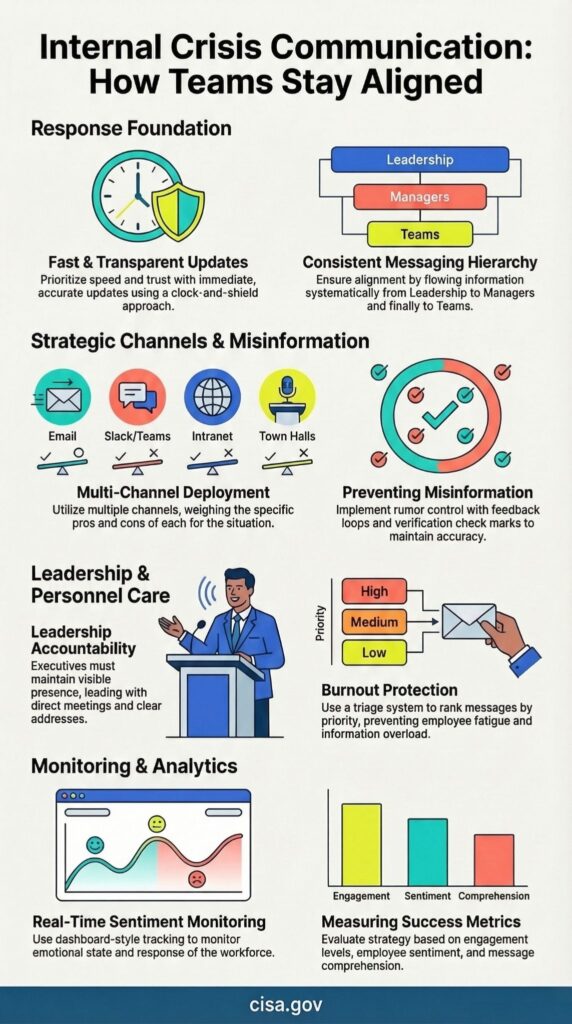
- Internal crisis communication protects employee trust. Delivering fast and transparent updates prevents misinformation from spreading and helps employees stay aligned with leadership decisions.
- Consistent messaging keeps everyone informed and reduces confusion. When leaders, managers, and internal channels share the same information, employees understand the situation and respond more confidently.
- Real-time monitoring helps organizations adjust communication quickly. Tracking employee sentiment allows leaders to refine messages, support morale, and maintain psychological safety across teams.
Internal Communication During Crises
Internal crisis communication keeps employees informed when something goes wrong. It provides clear updates about what happened, what the company knows, and what actions teams should take next.
Insights from CISA
“Security plans should account for communications both within (internal) and outside (external) the organization, as appropriate.” – CISA
During events such as security incidents, operational failures, or public controversies, employees often rely on internal communication before outside news sources. When information arrives late or appears inconsistent, rumors spread and productivity drops.
Leadership must take responsibility for early communication. Employees expect to hear from executives when a crisis affects company operations or workplace stability. A short, direct update from leadership usually prevents confusion and shows accountability.
A basic internal crisis communication structure usually includes several tools:
- A crisis communication playbook with escalation procedures
- Prewritten leadership announcement templates
- Manager talking points for team discussions
- Internal FAQ documents that address early questions
- Scheduled updates through email, Slack, or Teams
These systems help employees know where updates will appear and how leadership will communicate during the crisis. When information flows through a clear structure, teams stay coordinated and the organization responds faster.
Prevent Internal Misinformation

Preventing internal misinformation starts with early, clear communication. When employees do not receive updates during a crisis, they fill the gap with speculation.
Workplace platforms such as Slack or internal chats can spread rumors quickly if leadership stays silent. Internal crisis communication works best when organizations explain what they know, what they are still investigating, and when the next update will come.
Transparency reduces uncertainty. Employees may not like difficult news, but most prefer honest explanations over silence. When leaders acknowledge problems and provide context, teams are less likely to rely on informal conversations or unverified claims.
A simple rumor-control process often includes a few practical steps:
- Monitor employee sentiment through surveys, feedback tools, or internal channels
- Share verified updates through a central source such as the company intranet
- Give managers clear scripts so responses stay consistent
- Update internal FAQ pages as new questions appear
- Correct misinformation directly instead of ignoring it
These actions help employees understand where accurate information lives during a crisis.
Transparency and Employee Trust
Transparency in internal crisis communication means sharing confirmed information as soon as it becomes possible. Employees expect honest explanations about operational changes, security issues, or workforce decisions.
Real Time Internal Updates

Real time internal updates help organizations keep employees aligned while a crisis is still unfolding. When teams work across different locations, time zones, and hybrid setups, information can easily become fragmented. Internal crisis communication prevents that problem by creating a clear system for updates that everyone recognizes.
A structured update system usually includes several key channels:
- Email alerts for official announcements and policy updates
- Slack or Teams crisis channels for fast operational coordination
- Intranet alerts for detailed documentation and resources
- Virtual town halls for leadership communication
- Manager briefings to clarify updates for frontline teams
These channels support different types of communication, but they should always point employees toward the same source of truth.
Communication Channel Comparison
| Channel | Primary Use | Strength | Limitation |
| Email announcements | Official company updates | High reach and documentation | Information overload risk |
| Slack or Teams channels | Real time coordination | Fast interaction and visibility | Potential rumor spread |
| Intranet alerts | Central resource hub | Detailed information storage | Requires active access |
| Town hall meetings | Leadership visibility | Builds employee trust | Scheduling delays |
A layered communication approach helps organizations move fast while still keeping information accurate and centralized.
Battling Burnout in Crisis Communication Teams
Internal communications teams often face heavy pressure during long crisis events. The work rarely stops. Teams move between drafting operational updates, answering employee concerns, supporting executives, and coordinating with HR or legal. Over time, this constant demand leads to fatigue.
As highlighted by McKinsey & Company
“Communicate confidently, consistently, and reliably. Uncertainty breeds fear and confusion.” – McKinsey & Company
Many communication professionals describe the same pattern. When a crisis hits, internal communication becomes nonstop. Every social issue becomes an employee FAQ overnight.”
The issue is structural. Internal communication teams often receive urgent requests from many directions at once. Without clear priorities, every message appears critical. That quickly pushes teams toward burnout.
Communication leaders usually manage this pressure through a simple triage structure:
- Classify requests by urgency and operational impact
- Prioritize updates related to employee safety or business continuity
- Pause nonessential communication projects
- Assign crisis roles across communications, HR, legal, and leadership
- Set response timelines for different message types
These boundaries protect communication teams during high-pressure situations. When priorities stay clear, teams focus on the messages that matter most instead of reacting to every request that appears.
Internal vs External Crisis Communication
Credits : Spring Point Partners
Internal crisis communication focuses on employee alignment. External crisis communication focuses on public perception and media response. Both happen at the same time during major incidents, but they serve different purposes.
External messaging usually centers on reputation management, regulatory statements, and public accountability. Internal communication has a different job. Employees need to know what happened, what it means for their work, and what actions leadership expects from them. Clear internal guidance helps teams stay coordinated during disruption.
Problems begin when organizations focus on public messaging while employees receive little information. That gap creates confusion inside the company. Employees may then turn to outside channels, including social media or professional networks, where internal uncertainty can quickly become public discussion.
A structured crisis communication plan helps prevent that disconnect. Internal updates and public statements should move together, even if the details differ.
Strong coordination often involves several teams working together:
- Internal communications teams
- Human resources leadership
- Legal and compliance departments
- Public relations teams
- Executive leadership
When these groups coordinate messaging, employees hear the same core message that external audiences receive. This alignment protects credibility while keeping the workforce informed and prepared.
FAQ
How does internal crisis communication support workforce alignment during disruptions?
Effective internal crisis communication keeps employees aligned when uncertainty spreads across an organization. Clear employee crisis messaging explains priorities, responsibilities, and the current situation so teams understand what actions to take.
Regular internal stakeholder updates also prevent confusion across departments. When leaders communicate consistently, the workforce can coordinate tasks more efficiently and support a unified organizational crisis response.
What role does transparency during crisis play in employee trust building?
Transparency during crisis strengthens employee trust building because employees expect honest explanations during difficult situations. Strong crisis leadership communication shares confirmed facts, acknowledges uncertainty, and explains why decisions are made.
This approach supports authenticity crisis talk, which shows respect for employees and encourages openness. When leaders communicate honestly, employees are more likely to remain cooperative and engaged.
How can organizations prevent misinformation and rumor control internally?
Organizations can manage rumor control internal by sharing verified updates quickly and consistently. Leaders should distribute clear messages through intranet crisis alerts, email blast crisis updates, or other official communication channels.
Encouraging fact-checking employees and addressing misinformation internal directly helps employees rely on accurate information. Frequent updates reduce speculation and reinforce confidence in leadership communication.
Why are crisis escalation protocols important for internal organizational response?
Clear crisis escalation protocols help organizations respond faster when problems grow more serious. These procedures define who communicates information, which teams respond first, and how updates move across departments.
Structured rapid response comms ensures employees receive timely guidance. Strong escalation processes also support business continuity comms, which helps organizations maintain operations while managing internal communication during the crisis.
How do internal communication channels help maintain morale during crisis?
Reliable communication channels help sustain morale maintenance crisis efforts when employees face uncertainty. Leaders can share updates through Slack crisis channels, Teams crisis updates, or scheduled town hall crisis meetings.
These channels allow employees to ask questions and receive clarification through two-way crisis dialogue. Open communication helps employees feel informed, supported, and included in the organization’s response.
Stay Clear When Internal Communication Gets Tested
When a crisis hits, messages move fast and employees interpret updates in different ways, creating confusion.
Communication teams often struggle to see where misunderstandings start. Tools like BrandJet give leaders visibility into how internal messages are received and where concerns arise. By spotting issues early, teams can respond quickly, keep employees aligned, and maintain trust even when communication is under pressure.
References
- https://www.cisa.gov/sites/default/files/2023-10/CISA_AASB_Security_Planning_Workbook_508_Compliant_20230929.pdf
- https://www.mckinsey.com/capabilities/mckinsey-digital/our-insights/the-cios-moment-leadership-through-the-first-wave-of-the-coronavirus-crisis
Related Articles

More posts

Prevent Internal Misinformation in Organizations
Prevent internal misinformation by establishing clear communication protocols, verification processes, and a culture...
Influencer Crisis Detection for Modern Brands
An influencer crisis can cost you trust and revenue. It’s about spotting the danger signs before they blow up. The...

Local Crisis Reporting Dashboard: Features and Guide
A local crisis reporting dashboard centralizes real-time incident data, fires, floods, power outages, and accidents,...