


Table of Contents
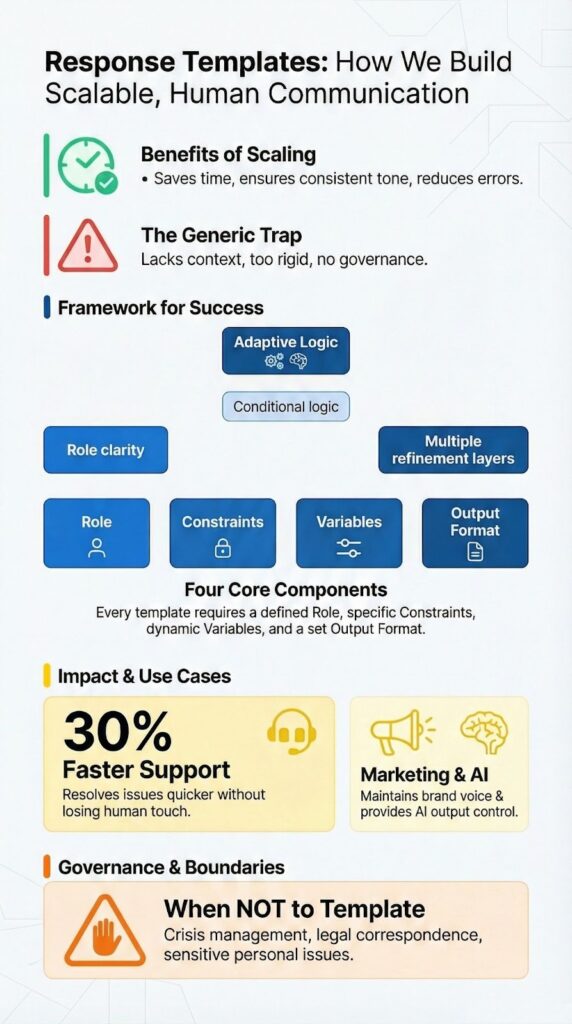
Response templates are pre-written messages you can use over and over. They help teams reply quickly and keep a consistent tone, whether in customer service or marketing. Using them cuts down on errors and saves a huge amount of time for everyone.
This isn’t just theory; companies of all sizes use these templates to make their communication smoother and more reliable. This guide walks you through creating practical templates that actually work, and how to adjust them so they still feel personal. If you’re tired of writing the same thing repeatedly, keep reading.
Key Takeaways
- We use response templates to improve speed, consistency, and brand safety across channels.
- We avoid generic templates by designing adaptive frameworks with variables and conditions.
- We apply response templates differently for crises, support, sales, and AI prompts.
What Response Templates Are and Why We Use Them
A response template is just a reusable format for your replies. It standardizes communication but still lets you change the important details. Research from Harvard Business Review found that standardizing workflows can reduce response times by about 30% in busy places.
The main reason we use them is simple: they save mental energy. In email, chat, or even with AI, they stop your team from having to write the same thing over and over. Instead, you pick a structure that works, fill in the blanks, and send it.
You see them everywhere:
- Customer service scripts for help desks.
- Outreach templates for sales or PR teams.
- Prompt templates for AI chatbots.
Good templates do more than provide text. They include notes on the right tone, highlight fields that must be filled in, and often have rules for when to hand an issue to someone else.
This turns a basic canned response into a reliable framework that anyone can use, which cuts down on errors and keeps replies consistent. The goal isn’t to sound robotic, but to free up time for the parts of the job that actually need a human touch.
Why Generic Templates Fail in Real Use

Generic templates fail because they ignore context, emotion, and edge cases. This is particularly evident when dealing with ambiguous keywords where a single term has multiple meanings. Research highlights this challenge:
“Ambiguous queries pose real challenges for web search engines due to versatility of information… Query terms are inherently ambiguous due to polysemy, and most queries are short… resulting in retrieval of many irrelevant pages.” – KSII Transactions on Internet and Information Systems [1]
Forums like r/PromptEngineering show widespread frustration with rigid templates that produce vague or unsafe replies. A 2024 review cited by Gartner found 42% of support agents rewrite canned responses due to missing context, wasting time and causing frustration. The solution is layered design that accounts for these “versatile” information needs.
Build Adaptive Response Frameworks
An adaptive framework has a fixed core but flexible parts. Start with mandatory sections: acknowledgment, action, and next steps. Then add optional modules based on the specific scenario.
Use variables for details like names, dates, and platforms. This approach, used by top helpdesk systems, makes replies feel personal and relevant.
A practical framework includes:
- Clear role and authority definitions.
- Rules for tone and message length.
- Consistent output structure enforcement.
This makes templates resilient and useful in real conversations.
Crisis Communication Response Templates That Protect Brands

Crisis templates are pre-approved messages for emergencies. Because effective crisis management relies on speed, FEMA says consistent early messaging can reduce misinformation by 60%. We use them to act fast and stay accurate.
Every template needs four parts: acknowledge the issue, accept responsibility, state the action being taken, and promise when you’ll update people. This follows FEMA and other crisis leadership advice.
Social Media Crisis Message Templates
These are for quick public replies to control the story. Utilizing pre-drafted social media crisis message templates helps you keep them short, stick to facts, and avoid guessing. Always add a timestamp and say when the next update is coming. Standardize these three things:
- Acknowledging the problem.
- Stating what’s being done.
- Committing to more information.
Brand Apology Template Examples
A real apology takes blame and explains the fix. Reviewing brand apology template examples can help you ensure the message includes responsibility and a plan to make it right. Don’t use “if” or “but.” Say what happened and what you’re changing. Make sure it’s legally sound but doesn’t sound like a lawyer wrote it.
Crisis Response Email Templates
Send these to stakeholders for detailed updates. By following crisis response email templates, you can structure them clearly: what happened, what we know, what we’re doing, and when we’ll write again. This keeps everyone informed consistently, which is critical in a crisis.
Comparing Response Template Types by Use Case
This overview shows how different templates fit specific jobs, helping teams choose the right one quickly. The risk level and required information change for each type.
- Customer service scripts handle support tickets. The risk here is usually medium.
- Crisis response templates are for incidents and public relations. This carries a high risk.
- Outreach templates are for sales or PR pitches. The risk level is medium.
- AI prompt templates guide language model outputs. The risk ranges from low to medium.
The table below shows how we apply different response template categories across functions.
| Template Type | Primary Use | Key Variables | Risk Level |
| Customer service script | Support tickets | Name, issue, SLA | Medium |
| Crisis response template | Incidents and PR | Platform, severity, timing | High |
| Outreach template | Sales and PR | Persona, offer, channel | Medium |
| AI prompt template | LLM outputs | Role, rules, format | Low to Medium |
The goal is to match the template’s rigidity to the situation’s stakes. Whether you need phone crisis script examples or specialized influencer crisis response templates, a crisis needs a tight structure, while a sales email allows for more adaptation.
How We Operationalize Response Templates With AI
We plug response templates directly into AI systems to manage what they produce. This process effectively mirrors the “Detect-Clarify-Respond” framework found in recent computational linguistics research. According to :
“Resolving ambiguity through interaction… requires systems to disentangle two factors that contribute to model uncertainty… Systems for this task must identify instances where the user’s intent is ambiguous and it has the knowledge required to respond after clarification.” – Findings of the Association for Computational Linguistics (ACL) [2]
This creates a feedback loop where our templates are active tools, not just forgotten documents. The process involves three main steps:
- Integration: Embedding the template as a strict instruction set within the AI’s prompt.
- Monitoring: Actively reviewing AI outputs for consistency with our desired messaging.
- Iteration: Updating the template rules based on what the monitoring reveals.
This practical loop is what separates a working system from one that just sounds good on paper. It forces the template to prove its worth constantly, adapting to new problems or changes in how people communicate. Without it, even the best-designed template can quickly become useless.
Response Templates as a Strategic Asset
Credits : Etactics
Thinking of templates as mere shortcuts misses their real value. They are a core part of your communication infrastructure. A well-built template does three things: it protects your brand’s consistent voice, reduces the risk of saying the wrong thing during a crisis, and allows your team to scale their efforts without the message becoming fragmented.
This isn’t a one-time setup. We schedule formal reviews every quarter, run them through simulated high-pressure scenarios, and continually tweak the language based on hard data, like customer sentiment scores and support ticket resolution rates.
Companies which systematize their communication this way navigate turbulent times more effectively than their peers. The maintenance work is non-negotiable and follows a clear cycle:
- Scheduled Audits: Every three months, we review the entire template library for relevance and tone.
- Pressure Testing: We use crisis simulations to find where a template’s wording fails or becomes awkward.
- Data-Driven Updates: We adjust templates based on analytics from customer interactions and brand monitoring reports.
This disciplined process of review, test, and refine transforms a simple text snippet into a reliable strategic asset that grows with your company.
FAQ
What is a response template, and when should I use one instead of writing manually?
A response template is a pre-written reply used for common communication scenarios. It is helpful when answering repetitive questions, confirmations, or complaints. Using a reply template or canned response saves time, reduces errors, and ensures consistent tone. Manual writing is better only when a situation is unique or highly sensitive.
How do response templates improve speed and consistency in daily communication?
Response templates provide a standard response that teams can reuse across email, chat, or ticket systems. A message template or quick reply reduces response time and prevents wording inconsistencies. A clear response framework helps teams deliver accurate information quickly, even when handling a high volume of messages.
Can response templates still feel personal and natural to users?
Response templates can feel personal when they include editable fields for names, context, and next steps. A personalized template or dynamic response allows customization without rewriting each message. When written clearly and conversationally, a pre-written reply supports empathy while maintaining a consistent and structured response pattern.
Which response templates are most useful for support and inquiry handling?
The most useful templates include inquiry replies, complaint templates, acknowledgment replies, follow-up templates, and resolution templates. These cover most customer interactions. A defined support reply format or helpdesk script helps teams respond clearly, accurately, and calmly, especially during urgent or emotionally charged situations.
How should response templates be organized and maintained over time?
Response templates should be organized by purpose, communication channel, or workflow response. Regular reviews are necessary to keep wording accurate and easy to understand. Updating reusable replies or response snippets based on user feedback ensures templates remain relevant, effective, and aligned with real communication needs.
Response Templates That Drive Consistency and Trust
Response templates create clear, reliable communication when it matters. They align teams, guide AI outputs, and protect your reputation. Moving from generic replies to adaptive frameworks turns them into a competitive edge.
This requires discipline: consistently reviewing, testing, and refining your templates as your brand evolves. The right tools make this process sustainable.
Build your adaptive response framework with BrandJet today.
References
- https://www.researchgate.net/publication/283436467_A_Hybrid_Query_Disambiguation_Adaptive_Approach_for_Web_Information_Retrieval
- https://aclanthology.org/2025.findings-naacl.306.pdf
Related Articles
- https://www.brandjet.ai/blog/crisis-management
- https://www.brandjet.ai/blog/social-media-crisis-message-templates/
- https://www.brandjet.ai/blog/phone-crisis-script-examples/
- https://www.brandjet.ai/blog/influencer-crisis-response-templates/
- https://www.brandjet.ai/blog/brand-apology-template-examples/
- https://www.brandjet.ai/blog/crisis-response-email-templates/

More posts

Prevent Internal Misinformation in Organizations
Prevent internal misinformation by establishing clear communication protocols, verification processes, and a culture...

Internal Crisis Communication: How Teams Stay Aligned
Internal crisis communication is the process organizations use to share clear, accurate information with employees...
Influencer Crisis Detection for Modern Brands
An influencer crisis can cost you trust and revenue. It’s about spotting the danger signs before they blow up. The...