


Table of Contents
Legal & PR coordination aligns legal compliance with public messaging. It requires shared workflows, defined approvals, and consistent narratives to communicate clearly without increasing legal or regulatory risk. Misaligned statements can escalate litigation, trigger penalties, or cause lasting reputation damage.
Many large organizations now treat this as a core function, not just an emergency fix, especially after failures during data breaches or mergers. If you manage brand risk, communications, or legal exposure, this guide explains how the process works and where it breaks down. Keep reading to see our approach at BrandJet and how you can apply it.
Key Takeaway
- Legal and PR alignment reduces litigation risk while preserving credibility across media, regulators, and stakeholders.
- Effective coordination depends on predefined workflows, not ad hoc approvals during crises.
- Centralized monitoring and message clearance help teams respond faster without compromising compliance.
Coordinate PR and Legal During Crisis
Coordinating PR and legal during a crisis needs a shared command structure. Legal sets the risk boundaries, while PR manages the clarity, timing, and audience impact of the message. Without this alignment, teams often send conflicting statements that increase liability.
The necessity of this partnership is fundamental to the discipline of communications. According to :
“To a large extent, the job of public relations is to optimize good news and to forestall bad news, but when disaster strikes, the public relations practitioner’s task, in consultation with legal counsel, is to assess the situation and the damage, to assemble the facts… to organize the client’s response, usually involving several complicated issues, to be both lucid and persuasive.” – Encyclopaedia Britannica [1]
By treating legal counsel and PR as “co-architects” of the narrative, BrandJet helps organizations ensure their response is both legally sound and publicly credible.
Key operational elements include:
- A pre-approved crisis communications strategy, signed off by counsel and executives.
- A single, trained spokesperson who understands media and legal boundaries.
- Real-time monitoring of press, social media, and AI summaries to catch narrative drift early.
This structure ensures you can move fast without improvising, which is where most failures happen.
Prevent Legal Backlash During Crisis
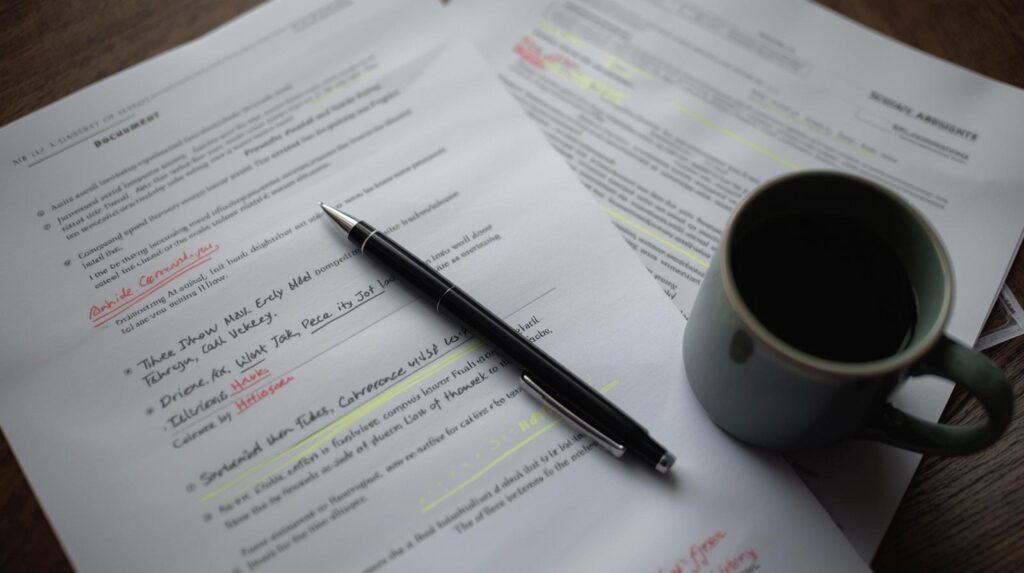
To prevent legal backlash, PR teams need to understand how public statements can create liability under defamation, securities, or disclosure rules.
Good coordination reduces the risk that a statement will be used against the organization in court or by regulators. Legal trouble often starts with well-meaning messages, like an early admission in a defamation case or a speculative comment during an antitrust probe.
The challenge is operating within legal guidelines while still meeting stakeholder expectations, especially during mergers or investigations where silence itself can be damaging.
Coordination works best when legal explains the reason behind a restriction, not just saying “no.” PR professionals who grasp concepts like privilege waiver or SEC filing rules can craft safer, yet still informative, messages.
Common prevention tactics:
- Route all external statements through both legal and communications leads.
- Review drafts for legal discoverability, not just tone.
- Use versioned, time-stamped talking points to track approved language.
At BrandJet, we help by monitoring how statements are echoed across news and AI models, letting teams respond before a bad narrative takes root.
Crisis Legal Team Workflow Guide

A clear legal workflow is crucial during a crisis. It stops messages from getting stuck in approval or leaking out wrong. The best plans treat a crisis like a standard operational drill, not a creative writing project.
The legal team’s job is to pin down the facts, weigh the risks, and check for legal requirements. The PR team then turns those approved facts into messages tailored for different audiences. Both groups need to work from the same timeline.
Here’s how a planned response stacks up against a chaotic one:
- Message Approval: A coordinated team uses a single review process.
- Spokesperson: The planned approach uses a pretrained, authorized person.
- Disclosure Timing: A good workflow aligns releases with regulations.
- Media Narrative: Coordination leads to a consistent, factual story.
Here is a simplified comparison of coordinated versus uncoordinated workflows.
| Element | Coordinated Legal & PR | Uncoordinated Response |
| Message approval | Single review loop | Multiple conflicting approvals |
| Spokesperson | Pretrained, authorized | Ad hoc or unauthorized |
| Disclosure timing | Aligned with regulations | Reactive or delayed |
| Media narrative | Consistent and factual | Fragmented and speculative |
This structure supports compliance public relations without sacrificing responsiveness.
Why Legal Teams and PR Teams Often Misalign
The misalignment between legal and PR teams usually comes from different incentives, not a lack of skill. Legal teams are focused on minimizing risk. PR teams are focused on managing public perception and moving quickly. In many companies, these two groups don’t work together until a crisis forces them to. By then, trust is low and time is short.
Research published emphasizes that modern brands cannot afford this disconnect:
“The most successful organizations treat PR not as a ‘megaphone’ for the legal team, but as a ‘strategic translator’… recognizing that ‘winning in the court of law’ is useless if the brand is ‘convicted in the court of public opinion.” – ResearchGate [2]
Key reasons for misalignment:
- Different core goals: Legal minimizes risk; PR manages perception and speed.
- Late collaboration: Teams often only meet under crisis pressure, when trust is already low.
- Separate data: Legal may not see real-time narrative shifts; PR may not understand legal discovery risks.
At BrandJet, we help bridge this gap by providing a shared view of brand perception, including how AI models are framing sensitive narratives.
Regulatory Affairs and Public Messaging
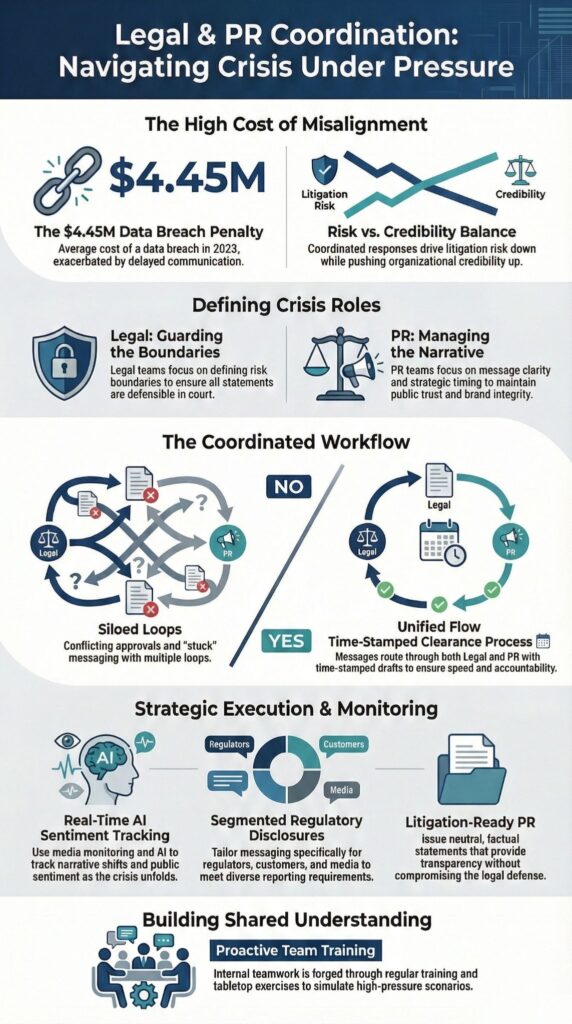
Messaging around regulatory affairs needs extreme precision, as a single statement can trigger an audit, a fine, or a full investigation.
Effective legal and PR coordination ensures that compliance language is both accurate for regulators and understandable for everyone else, often supported by crisis management tools to monitor communications in real time.
Industries like finance, healthcare, and tech deal with overlapping rules. During a data breach, for instance, communications must align with GDPR deadlines, state notification laws, and SEC guidance for public companies all at once.
Guidance from bodies shows that even with good technical fixes, delayed or unclear notifications can still lead to penalties. PR teams must work from legally approved facts, balancing strict compliance with clear, empathetic communication.
Effective coordination for regulatory messaging involves:
- Message matrices that map each audience to specific, approved disclosures.
- Formal, legal language for official regulator notices.
- Plain-language explanations for affected customers.
- Contextual, factual statements for the media, avoiding any speculation.
This segmented approach prevents the risk of over-disclosure while maintaining trust across all groups.
Litigation PR Tactics Without Compromising Defense
Credits : KLGatesLaw
Litigation PR aims to protect a company’s reputation during a lawsuit without influencing potential jurors or accidentally waiving legal privilege. It’s a difficult balance, but it’s possible with tight coordination between legal and PR.
Public statements can impact juror perceptions, settlement negotiations, and even appeal strategies. Courts now pay close attention to public commentary, especially in high-profile cases. The legal team sets strict boundaries based on ethics rules and court orders, and the PR team operates within those limits to provide context for filings, rulings, or settlements.
Common coordinated tactics include:
- Factual summaries: Announcing that a filing has been made, without arguing the case in public.
- Neutral process explanations: Clarifying procedural outcomes, like a summary judgment, without editorializing.
- Strategic timing: Releasing statements in a way that avoids prejudicing any ongoing court proceedings.
These approaches help maintain public credibility while fully respecting the legal constraints of an active case.
FAQ
How should teams manage legal PR coordination during a sudden data breach?
Begin with a crisis communications strategy that unites in-house counsel comms and PR in real time. Follow legal disclosure guidelines, prepare clear data breach notification PR, and use risk communication counsel to avoid overpromising.
Align legal media relations, guard against privilege waiver risks, and coordinate stakeholder engagement counsel so customers, regulators, and employees receive consistent, calm updates without speculation publicly.
What steps reduce reputational harm in class action or defamation crisis response?
Pair reputation management law with focused litigation PR tactics from day one. Train an attorney spokesperson, align corporate counsel PR, and follow bar association guidelines strictly.
Prevent discovery document leaks, plan juror bias mitigation where applicable, and design settlement announcement tips that balance transparency with legal protection while keeping all external messaging consistent and measurable for stakeholders across proceedings properly.
How can companies coordinate compliance public relations during an antitrust investigation?
Integrate regulatory affairs messaging with disciplined antitrust investigation spin that remains factual. Align shareholder communications legal with accurate SEC filing narratives and consult risk communication counsel regularly.
Maintain a structured whistleblower response plan, track docket monitoring comms, and ensure hearing preparation media avoids language that implies guilt or regulatory hostility toward employees investors customers partners and regulators at every stage.
What is a safe PR clearance process for client win press releases?
Route all drafts through in-house counsel comms and legal media relations before release. Check NDA public statements, prevent attorney-client privilege leaks, and respect work product doctrine PR.
Evaluate rainmaker promotion ethics, contingency fee optics, and law firm branding, verify facts, review indemnity provision spin, and secure written approvals to align marketing legal risk across every practice group and jurisdictional boundaries.
How should leaders message during bankruptcy reputation repair or firm dissolution comms?
Lead with empathy and present a clear summary judgment narrative that explains context. Coordinate corporate counsel PR with employee updates, creditor outreach, and stakeholder engagement counsel.
Apply merger announcement strategy principles for timing, manage adverse ruling narrative calmly, and prepare deposition soundbites that protect arbitration confidentiality PR while preserving trust with clients partners regulators and courts consistently across all jurisdictions.
Legal & PR Coordination as a Brand Risk Discipline
Legal and PR coordination must be an ongoing brand risk discipline, not a reactive task. Clear workflows and shared monitoring reduce both legal exposure and reputational harm. As AI and new channels shape perception, this alignment is more critical than ever.
Prepared teams handle crises, regulations, and litigation better. To centralize monitoring and improve coordination across human and algorithmic systems, see how BrandJet supports modern legal and communications teams.
References
- https://www.britannica.com/topic/public-relations-communications
- https://www.researchgate.net/publication/329127603_Winning_in_the_court_of_public_opinion_Exploring_public_relations-legal_collaboration_during_organizational_crisis
Related Articles

More posts

Prevent Internal Misinformation in Organizations
Prevent internal misinformation by establishing clear communication protocols, verification processes, and a culture...

Internal Crisis Communication: How Teams Stay Aligned
Internal crisis communication is the process organizations use to share clear, accurate information with employees...
Influencer Crisis Detection for Modern Brands
An influencer crisis can cost you trust and revenue. It’s about spotting the danger signs before they blow up. The...