


Table of Contents
A post-crisis internal debrief is a structured review held shortly after a major incident. Its purpose is to evaluate what happened, assess how well the response worked, and identify what needs to change before the next crisis. Most organizations hold this review to ensure details are still fresh and accurate.
From our perspective at BrandJet, we see these debriefs as a practical learning tool, not just a formal exercise. They help teams turn a stressful event into clear lessons, rebuild trust, and protect future performance. If you want your organization’s next crisis response to be measurably better, keep reading.
Key Takeaways
- A post-crisis internal debrief captures facts, decisions, and lessons while memory is still reliable.
- Psychological safety and clear structure determine whether teams share useful insights.
- Documented actions with owners and deadlines separate learning from repetition.
What Is a Post-Crisis Internal Debrief and Why Does It Matter?
A post-crisis internal debrief is a structured review held within 24 to 48 hours after an incident. Its purpose is to assess how well your response worked, identify the root causes, and improve readiness for next time. This process creates a shared, factual understanding of events by replacing assumptions with evidence.
As Edward Segal, a crisis management expert, notes in a contributor blog:
“After any crisis or significant challenge, companies should hold a debrief or ‘post-mortem.’ This is a critical time for an organization to look in the mirror and evaluate its performance, as well as its communication with stakeholders.”- Forbes [1]
The primary goals of a debrief are to:
- Reconstruct the timeline: Agree on a factual sequence of what happened.
- Evaluate the response: Assess speed, coordination, and what actually helped contain the crisis.
- Capture lessons learned: Focus on process and system failures, not individual blame.
- Create an action plan: Document specific steps to reduce vulnerability in the future.
In our work with teams at BrandJet, we see debriefs serve two critical roles: they are an operational tool for improvement and a way to rebuild team confidence.
When Should a Post-Crisis Internal Debrief Be Conducted?
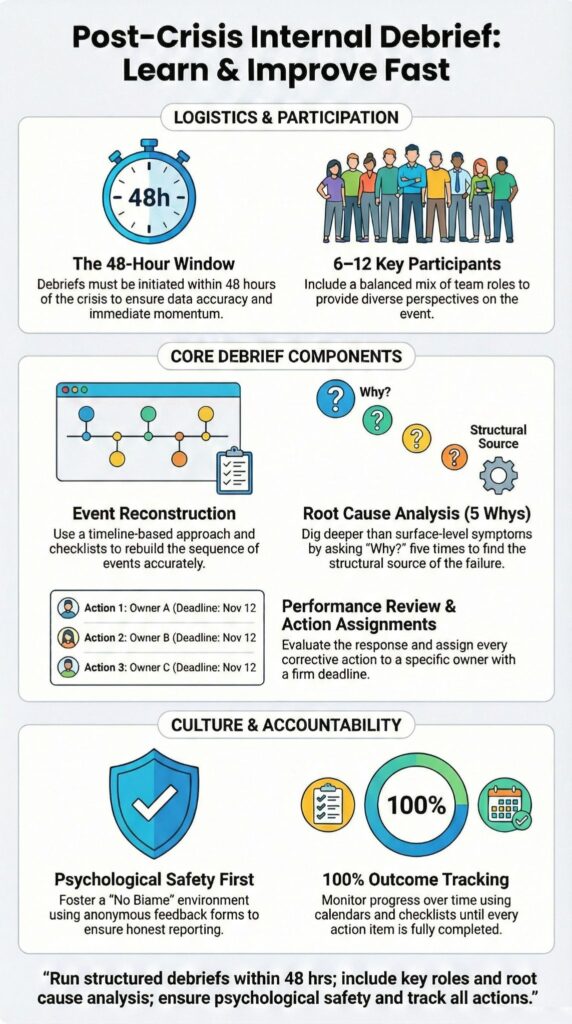
The best time to hold a post-crisis internal debrief is within 48 hours of the incident, before memories fade and personal narratives harden. Timing matters more than many teams realize. If you wait too long, the review becomes vague; if you rush it while emotions are high, feelings can block factual discussion.
Maintaining this discipline is vital for long-term growth. According to :
“Whether it’s a quick internal debrief or a full program report, documenting what worked (and what didn’t) is how you turn each response into a stronger one and build long-term resilience.” – Fundraise Up Blog [2]
Common approaches to debrief timing:
- Hotwash (within 24 hours): A quick, operational review for frontline responders to capture immediate issues.
- Formal evaluation (within 48 hours): A structured meeting for leadership and process owners to assess coordination and decisions.
- Follow-up session (7–14 days later): A calmer meeting focused on updating policies and long-term prevention strategies.
From our experience, the 48-hour window strikes the right balance. Teams have had a moment to recover but are still close enough to the events to recall specific details accurately.
Who Should Participate in a Post-Crisis Internal Debrief?
An effective post-crisis debrief should include both the people who made decisions and those who executed them, typically keeping the core group to 6–12 participants.
This balance supports strong crisis management by combining strategic oversight with operational reality, ensuring teams understand not just what happened, but why certain response decisions were made under pressure.
Inviting too few voices creates blind spots, while too many participants can make the discussion shallow and reduce psychological safety.
The goal is to include those who directly influenced the outcome, either through decisions or actions. Broader input from observers can be gathered later through surveys or written feedback.
Typical participants should include:
- The incident or crisis lead who coordinated the overall response.
- Frontline responders who have direct, hands-on experience from the event.
- Communications or brand owners involved in external messaging.
- Operations or tech leads connected to any root causes.
- A neutral facilitator to manage the discussion’s time and tone.
At BrandJet, we also stress including someone specifically responsible for documentation and tracking action items. This role is crucial for turning discussion into measurable follow-through, ensuring the debrief results in real change instead of just forgotten notes.
What Are the Core Components of an Effective Post-Crisis Debrief?

An effective post-crisis debrief includes five core components: reconstructing the timeline, assessing performance, collecting feedback, analyzing root causes, and assigning clear actions.
These components align closely with post-crisis recovery efforts, ensuring insights from the incident directly inform stabilization, operational fixes, and readiness for future disruptions.
The five core components in order:
- Timeline reconstruction: Build a shared, factual account of what happened using logs and records.
- Performance assessment: Identify what worked well and where there were clear gaps or delays.
- Feedback collection: Surface direct observations and insights from frontline participants.
- Root cause analysis: Use a method like the “5 Whys” to find underlying drivers, not just symptoms.
- Action assignment: Define specific improvements, assign owners, and set deadlines.
To clarify how these components fit together, the table below summarizes a structured debrief format.
| Debrief Component | Purpose | Output |
| Timeline reconstruction | Establish shared facts | Agreed event chronology |
| Performance assessment | Identify strengths and gaps | What worked and what did not |
| Feedback collection | Surface frontline insights | Verbatim observations |
| Root cause analysis | Identify underlying drivers | Documented causes |
| Action item assignment | Prevent recurrence | Owned improvement plan |
Organizations that document these outputs in a centralized knowledge repository build institutional memory and reduce dependency on individual recall.
Why Do Post-Crisis Internal Debriefs Fail in Practice?
Post-crisis debriefs often fail because of blame, rushed execution, and poor facilitation. When teams skip structured reflection, they break the learning loop that connects response performance to realistic crisis recovery timelines, making it harder to prevent repeated breakdowns in future incidents.
Our analysis of reviews across different teams shows the same preventable issues keep recurring.
The most common reasons debriefs fail:
- A culture of blame: Questions that sound like accusations shut down honest discussion immediately.
- Leadership dominance: When executives do most of the talking, frontline responders stop sharing crucial insights.
- Incomplete participation: Key people are often left out due to scheduling or shift work.
- No documentation: Lessons aren’t recorded, so the same mistakes are repeated.
- Rushing the process: Compressed sessions skip deep root cause analysis, leading to superficial fixes.
When participants fear negative consequences, they simply stop contributing. A debrief treated as a box-ticking exercise, rather than a genuine learning opportunity, will consistently fail to improve future performance.
How Does a Post-Crisis Internal Debrief Strengthen Stakeholder Confidence?
Credits :Eduta
A post-crisis internal debrief strengthens stakeholder confidence by producing clear facts, documented improvements, and a consistent follow-up plan. This process shows accountability and preparedness, not just promises. Stakeholders notice patterns; when they see an organization learning and adapting after a disruption, their trust grows.
Internal clarity directly affects external trust. Teams that understand what happened can communicate more consistently with customers, partners, and employees. Confidence is built through repeatable, visible actions.
A well-run debrief builds confidence by:
- Creating clear communication: Aligning the team on facts to prevent mixed messages.
- Demonstrating accountability: Leaders can reference documented lessons and specific actions taken.
- Showing prevention: Stakeholders see concrete steps to reduce future risk.
- Boosting morale: Employees feel heard, which improves service quality and resilience.
When the debrief’s findings lead to updated policies, playbooks, and training, that confidence compounds over time.
Stakeholders may not see the meeting itself, but they experience its effects through more reliable operations and clearer communication. Treating the debrief as a formal, disciplined process sends a strong signal that crises are taken seriously and used as a catalyst for improvement.
FAQ
What is the difference between a post-crisis review and a crisis debriefing
A post-crisis review examines the full incident after-action, including decisions, timelines, and outcomes. Crisis debriefing focuses on people, stress responses, and immediate learning. Both follow a structured debrief format.
Together they support timeline reconstruction, communication gaps analysis, and performance assessment. Using both ensures teams capture what went well, what could improve, and prevention strategies without undermining a blame-free review culture.
How do we run a lessons learned session without blaming individuals
Begin with a psychological safety debrief and clearly state rules for a blame-free review. Use root cause debrief methods such as the 5 whys technique to focus on system failures rather than personal mistakes.
Collect frontline responder feedback and reinforce leadership accountability. Frame the meeting as a team retrospective and crisis response review so participants can share errors and improvement recommendations without fear.
What should be included in an effective after action report
An effective after action report should include event chronology, decision point mapping, containment success factors, and failure mode review. Add structured feedback collection, clear action item assignment, and a prioritization framework.
Document improvement recommendations and required policy updates. This approach turns post-incident analysis into a practical quality improvement tool that directly supports crisis playbook updates.
How can we capture insights quickly with an operational hotwash
An operational hotwash is a rapid response evaluation held immediately after the incident. It captures fresh frontline responder feedback, shift-based debrief notes, and group chat debrief inputs.
Use a structured review process to record what went well, what could improve, and specific communication gaps. This method reduces recency bias and ensures accurate input for a centralized hub debrief.
How do we turn debrief outcomes into real change
Use an action tracking system to connect each action item to an owner, deadline, and success metric. Store results in a documented repository or knowledge repository to strengthen institutional knowledge.
Link findings to crisis recovery plan updates, vulnerability reduction actions, and employee resilience building programs. Conduct regular crisis management audits and stakeholder debriefs to maintain stakeholder confidence and demonstrate continuous operational improvement.
Post-Crisis Internal Debrief as a Continuous Improvement Practice
A post-crisis internal debrief is an ongoing discipline, not a one-time meeting. It strengthens response quality, communication, and team trust.
At BrandJet, we see the best results when debrief insights directly feed into monitoring and policy updates, making improvement measurable. To build this discipline and connect insight to action, explore how BrandJet supports structured learning and follow-through.
References
- https://www.forbes.com/sites/edwardsegal/2021/05/24/the-importance-of-holding-crisis-management-debriefs/
- https://fundraiseup.com/blog/emergency-fundraising/
Related Articles

More posts

Prevent Internal Misinformation in Organizations
Prevent internal misinformation by establishing clear communication protocols, verification processes, and a culture...

Internal Crisis Communication: How Teams Stay Aligned
Internal crisis communication is the process organizations use to share clear, accurate information with employees...
Influencer Crisis Detection for Modern Brands
An influencer crisis can cost you trust and revenue. It’s about spotting the danger signs before they blow up. The...