


Table of Contents
Preventing legal backlash during a crisis requires early legal involvement, disciplined communication, and precise documentation. This approach limits liability and regulatory exposure. Businesses that act without structure often create evidence that fuels later lawsuits, especially during fast-moving incidents like data breaches.
Unmanaged public narratives can quickly escalate risk across news and AI systems, turning a manageable problem into a prolonged legal fight. This article explains the practical steps to reduce that risk, helping you protect your organization and make decisions with confidence. Keep reading to understand how preparation and control directly shape your legal outcomes.
Key Takeaway
- Early legal counsel engagement reduces escalation risk and preserves privilege during high-pressure decisions.
- Documentation discipline creates defensible records that support compliance and litigation prevention.
- Centralized crisis communication limits contradictory statements that often trigger lawsuits and regulatory scrutiny.
How does early legal engagement reduce crisis-related legal exposure?
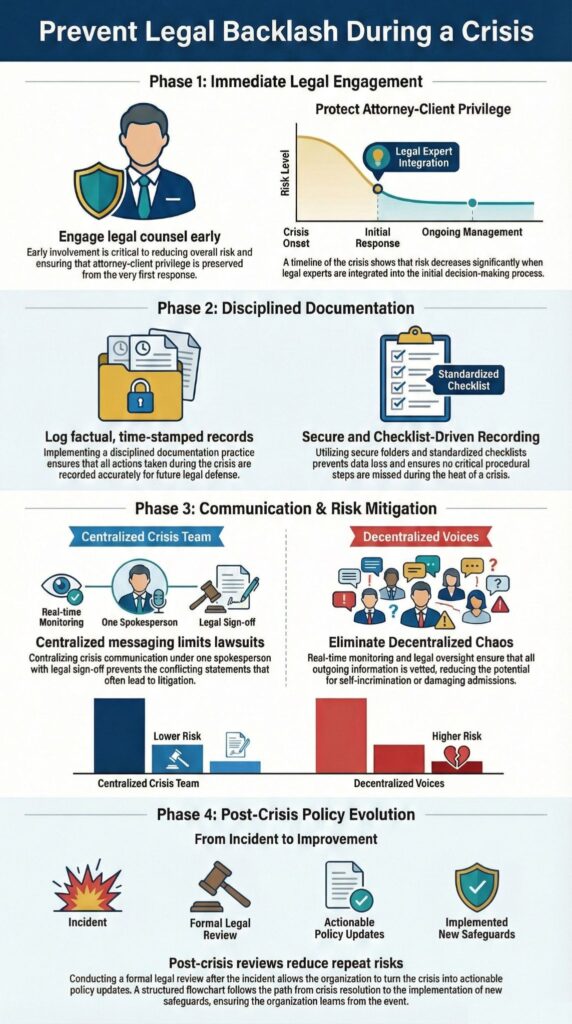
Bringing in legal counsel right at the start of a crisis is one of the most effective ways to reduce legal exposure. It helps control risk, preserve attorney-client privilege, and guide decisions before they escalate into lawsuits or regulatory problems. As noted :
“Effective crisis management involves planning, training, and communication to ensure that organizations can respond swiftly and effectively to minimize damage and restore normal operations. Legal professionals may assist organizations in developing crisis management plans that comply with regulations and protect against liability.” – US Legal Forms Encyclopedia [1]
How early legal involvement changes outcomes:
- Preserves privilege: Route all internal crisis discussions through legal counsel from the very first report.
- Mandates review: Require legal approval before any employee termination, customer notification, or regulatory disclosure.
- Assesses exposure: Use counsel to evaluate contract breaches, liability clauses, and insurance coverage terms.
- Documents decisions: Align executive decision logs with legal standards to support board liability protections.
From a brand perspective, this early alignment between legal and PR also improves damage control. It enforces a single, unified message across all channels, which stops conflicting narratives from being amplified by the media or AI systems.
Why is documentation your strongest legal defense during a crisis?
Detailed, time-stamped records are your strongest legal defense during a crisis, forming the backbone of disciplined crisis management when every decision may later be scrutinized.
They create a clear, factual narrative that proves your decisions were lawful and timely if a dispute or investigation arises. Without this documentation, it’s nearly impossible to demonstrate intent, compliance, or proper sequence when every action is later scrutinized.
Good documentation supports multiple critical needs: it ensures evidence is preserved for e-discovery, helps avoid claims of destroyed records, and meets tight regulatory reporting deadlines. In a data breach, for instance, regulators may demand a full incident report within days.
Key documentation practices that reduce legal exposure:
- Log every decision: Record the date, time, and the person responsible for each key choice.
- Separate facts from strategy: Keep factual records separate from legal strategy discussions to protect privilege.
- Secure the chain of custody: Use access controls to prove records haven’t been altered.
- Retain evidence systematically: Preserve material needed for forensic reviews or expert witnesses.
When your facts are verifiable, crafting public statements and handling media inquiries becomes much easier and reduces defamation risk. Over time, this discipline strengthens your position in any legal proceeding, from arbitration to trial.
What role does centralized crisis communication play in preventing lawsuits?
Centralized crisis communication plays a crucial role in preventing lawsuits by eliminating contradictory statements. When multiple people speak without coordination, inconsistencies appear. Plaintiffs’ lawyers use those inconsistencies to build cases for negligence or bad faith. Research published emphasizes the importance of a strategic, unified framework:
“Situation Crisis Communication Theory (SCCT) was developed to provide an evidence-based understanding to evaluate a proper internal crisis response when factoring in the stakeholders and reputational protection of the organization. A crisis manager can use this model to develop a response that takes an approach of denial, diminish, or rebuild to convey the desired level of crisis responsibility to the stakeholders.” – ResearchGate [2]
Key controls for a centralized approach:
- One spokesperson: Designate a single, trained person as the authoritative voice.
- Mandatory legal sign-off: Require legal approval for all external messages, including social media and investor updates.
- Internal “no-comment” policy: Enforce clear rules to stop unauthorized disclosures.
- Real-time monitoring: Track all channels to catch and correct misinformation quickly.
Before comparing approaches, it helps to see how structure affects risk outcomes across organizations.
| Approach | Legal Risk | Consistency |
| Centralized crisis team | Lower | High |
| Decentralized voices | Higher | Low |
How do post-crisis legal reviews prevent future backlash?

A structured post-crisis legal review is your best tool for preventing future backlash, especially when it strengthens ongoing legal PR coordination between counsel and communications teams.
It’s not about blaming people; it’s about fixing the system. Led by legal counsel, this review analyzes what went right, what went wrong, and exactly where your policies failed.
The goal is to convert a single incident into permanent policy improvements that boost compliance and readiness for the next event.
Effective steps for a post-crisis legal review:
- Identify policy gaps: Look for weaknesses in areas like employment law, cybersecurity reporting, or safety protocols that the crisis exposed.
- Update key documents: Revise your crisis playbooks, emergency response plans, and internal investigation procedures.
- Document changes formally: Create clear records of the updates for regulators, insurers, and your board.
- Integrate into training: Use the lessons learned to update employee training programs and incident reporting standards.
These reviews also inform practical monitoring. At BrandJet, we use the findings to adjust what keywords and risk signals we track, helping to catch problems earlier. This proactive approach strengthens your overall defense and reduces the chance of history repeating itself.
How does real-time monitoring help prevent legal backlash during a crisis?
Real-time monitoring helps prevent legal backlash during a crisis by spotting risk signals early, allowing teams to coordinate PR and legal responses before narratives solidify. This allows for timely legal review and a controlled response before issues spiral into lawsuits or regulatory action.
At BrandJet, we see this visibility as a direct legal safeguard. Monitoring captures how an incident is being discussed across news, social media, and even AI summaries. These third-party narratives can influence regulators, investors, and plaintiffs, and if left unchecked, can become part of the official record.
How monitoring directly supports legal defense:
- Detects allegations early: Flags emerging claims so legal counsel can engage immediately.
- Tracks misinformation: Identifies false narratives that could trigger reputational damage or shareholder suits.
- Spots regulatory language: Catches discussions tied to specific rules, like GDPR or SEC disclosures.
- Preserves records: Creates a time-stamped log that supports incident reporting and evidence preservation.
Monitoring also shows how AI models are framing the crisis, helping to correct persistent inaccuracies that create long-term risk. When you act on these insights, you manage compliance risks proactively instead of just reacting to damage.
How does real-time monitoring help prevent legal backlash during a crisis?
Credits : Minc Law
Real-time monitoring spots legal trouble before it escalates. It watches public chatter, news, and even how AI models summarize your crisis. This gives your team a chance to fix misinformation fast and keep everyone’s messaging on the same page, which helps avoid lawsuits or fines.
Here are the key ways it helps:
- It finds false claims early, so you can correct the record before they spread.
- It flags comments from employees or partners that might break company rules.
- It tracks what regulators and journalists are focusing on, so you can update stakeholders at the right time.
- It watches AI-generated summaries that could shape the long-term story about your brand.
From a legal standpoint, this monitoring isn’t just reactive. It builds a documented timeline of events, which is crucial for showing you acted responsibly. By catching risks early and responding clearly, you turn monitoring into a powerful tool for preventing legal backlash.
FAQ
How can legal risk management reduce lawsuits during a company crisis?
Legal risk management helps organizations identify legal exposure early, before issues escalate into formal lawsuits.
It supports litigation prevention by mapping potential claims, reviewing contract breach mitigation options, and assessing liability limitation clauses. When combined with timely legal counsel engagement and strict documentation best practices, this approach reduces the risk of class action defense situations and supports long term shareholder lawsuit prevention.
What should a crisis communication strategy include to avoid defamation and misstatements?
A crisis communication strategy must include a unified messaging policy, formal public statement review, and clear media relations crisis procedures. These controls reduce the risk of defamation and inconsistent messaging.
Social media guidelines crisis policies also limit unauthorized posts. Executive decision logging ensures accountability and provides a record if statements are later questioned in legal or regulatory reviews.
How do documentation best practices protect evidence during investigations?
Documentation best practices ensure compliance with evidence preservation rule requirements, spoliation avoidance, and proper chain of custody records. These measures prevent disputes over altered, missing, or improperly handled information.
When combined with e discovery readiness, privilege log maintenance, and a formal internal investigation protocol, organizations strengthen their position during regulatory investigation prep and potential litigation.
What steps are critical after a data breach response to limit liability?
A proper data breach response must include a formal cybersecurity incident report and a defined phishing response protocol. Organizations must also address regulatory compliance crisis obligations, including GDPR penalty prevention and CCPA data rights crisis requirements.
A timely stakeholder notification plan is essential. These actions reduce legal exposure, support insurance coverage crisis claims, and lower the risk of class action litigation.
Why is post crisis review essential for future litigation prevention?
Post crisis review identifies weaknesses in emergency response protocol, compliance audit crisis findings, and incident reporting standards. It also documents improvements for board liability shield and executive decision logging.
This process strengthens regulatory compliance crisis readiness and improves long term litigation prevention by reducing the likelihood of repeat failures that could trigger new legal actions.
Prevent Legal Backlash During a Crisis With Structured Control
Preventing legal backlash in a crisis requires preparation, discipline, and coordination. Key actions are early legal counsel, strong documentation, centralized communication, and structured post-crisis reviews.
At BrandJet, we help you monitor crises across public and AI-driven channels, so your legal and communications teams can act with clarity. Managing perception and process together reduces uncertainty and protects value. To strengthen your crisis readiness with intelligent monitoring, start with BrandJet.
References
- https://legal-resources.uslegalforms.com/c/crisis-management
- https://www.researchgate.net/publication/395716342_Crisis_Communication_in_Historical_Legal_Contexts
Related Articles

More posts

Prevent Internal Misinformation in Organizations
Prevent internal misinformation by establishing clear communication protocols, verification processes, and a culture...

Internal Crisis Communication: How Teams Stay Aligned
Internal crisis communication is the process organizations use to share clear, accurate information with employees...
Influencer Crisis Detection for Modern Brands
An influencer crisis can cost you trust and revenue. It’s about spotting the danger signs before they blow up. The...